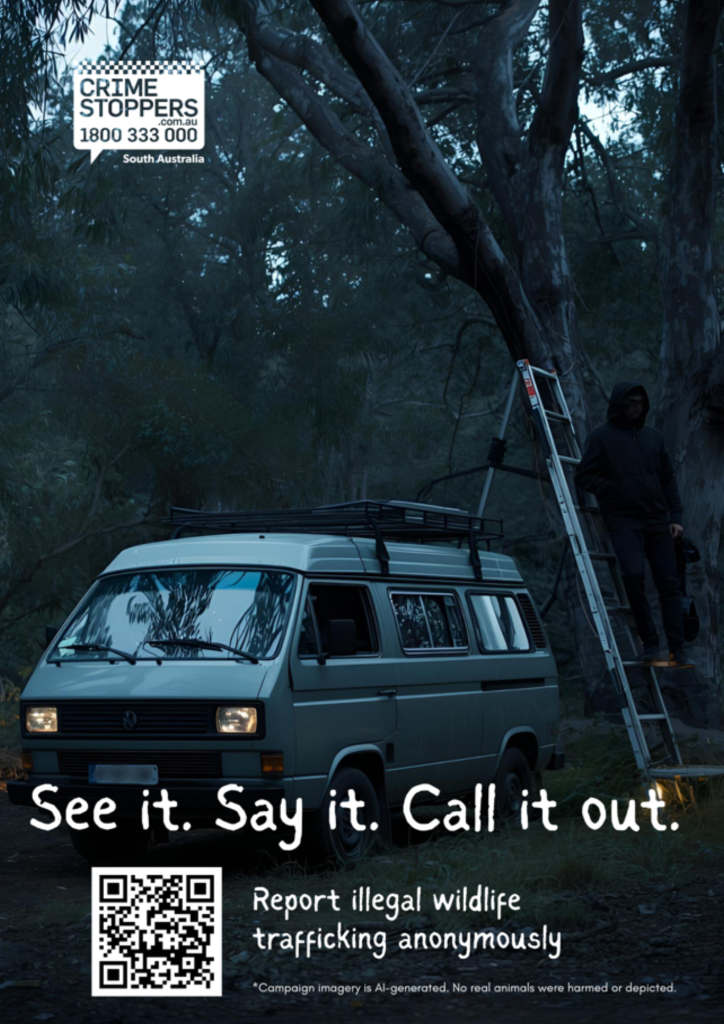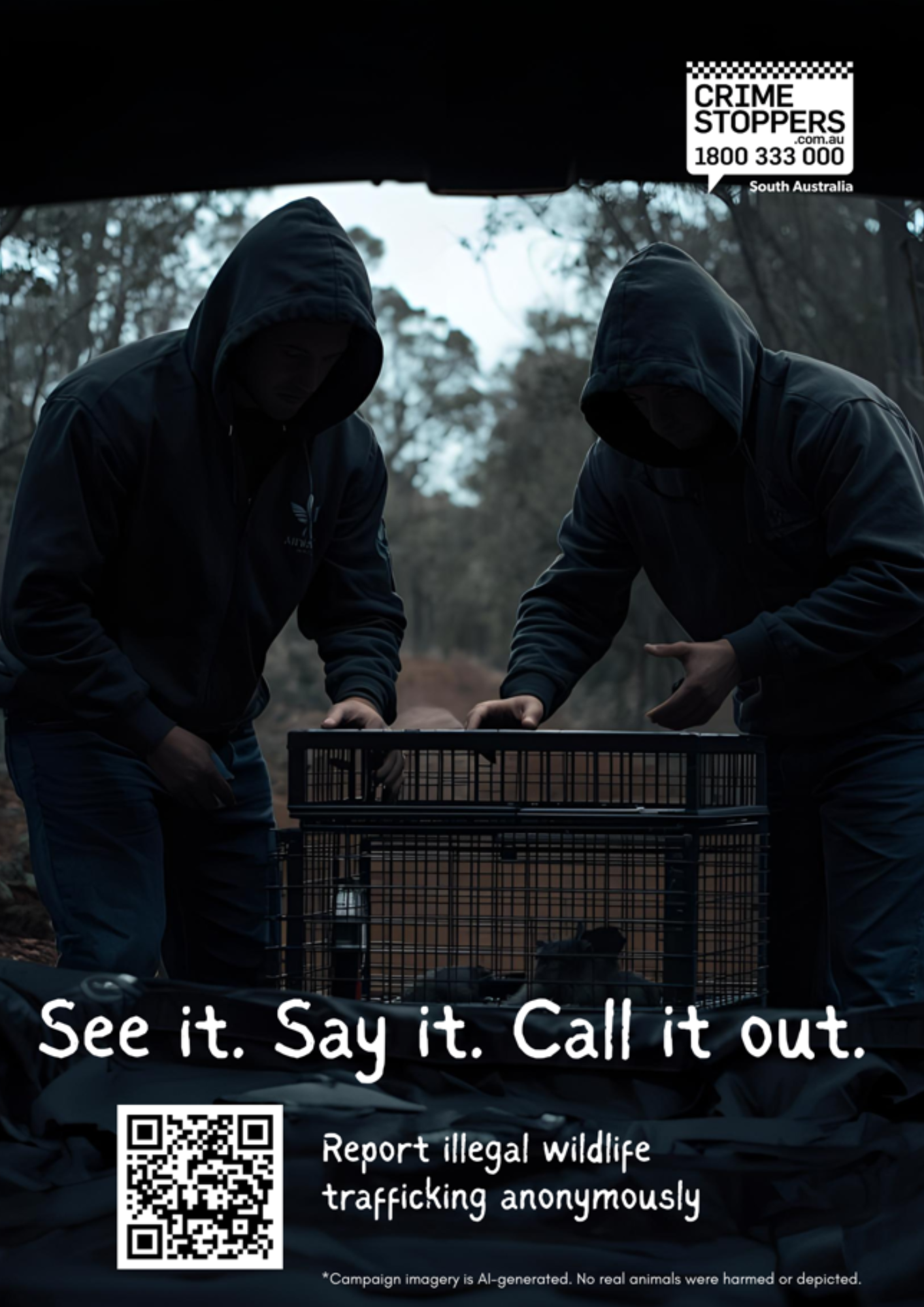
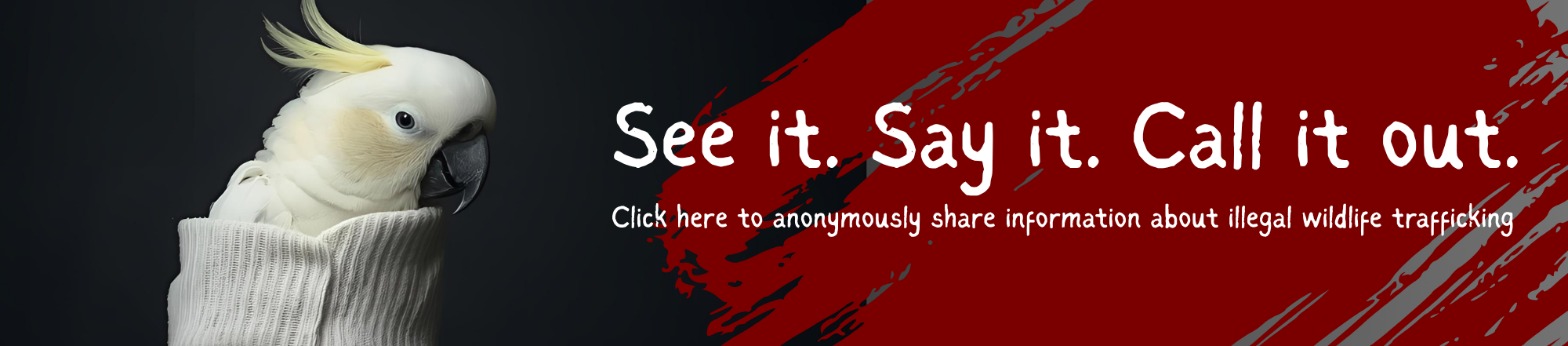
Wildlife belongs in the wild – which is why we want you to Call It Out!
South Australia is home to some of the world’s most extraordinary wildlife – from brightly coloured parrots to shingleback lizards and unique invertebrates.
But there’s a dark side. Every year, native animals are harvested from the wild, stuffed into boxes, socks or suitcases and smuggled across borders to be sold for profit.
It’s cruel. It’s illegal – and it’s happening right here, right now.
That’s why Crime Stoppers South Australia, together with the Department for Environment and Water (DEW), has launched the Call It Out campaign. We’re shining a light on this hidden crime and giving you the power to help stop it.
What is wildlife trafficking?
Wildlife trafficking is the illegal harvest, trade, and transport of native animals, particularly for the exotic pet trade. In South Australia, traffickers can target:
- Parrots, particularly cockatoos and lorikeets.
- Reptiles, like shingleback lizards, blue-tongue skinks, snakes, monitor lizards and geckos.
- Native mammals, including possums and smaller marsupials.
- Bird eggs, often smuggled because they’re easy collect and conceal.
- Invertebrates, such as ants, spiders and scorpions, collected for illegal sale or export.
These animals can fetch thousands of dollars on the black market – but many suffer or die along the way.
Report illegal wildlife trafficking here.
Wildlife licences and legal trade
Not all wildlife trade is illegal. South Australia has a licensing system that allows people to legally keep, breed and trade certain native species under strict conditions. This system helps ensure animals are cared for responsibly and that wild populations aren’t exploited.
Someone legally buying or selling native wildlife must:
- Hold the appropriate permit or licence from the Department for Environment and Water.
- Display that permit number in any online listings (for species that require it).
- Only trade animals that were lawfully obtained.
- Keep accurate records of sales and acquisitions.
Some species are exempt from permits, while others require detailed record-keeping and proof of origin. If you’re unsure, always check the Department for Environment and Water website before buying, selling or keeping wildlife.
The Call It Out campaign is not about stopping lawful activity – it’s about helping authorities identify illegal trafficking that harms South Australia’s ecosystems, animals and reputation.
How are animals typically smuggled?
Traffickers use cruel and deceptive methods to hide animals and move them across state or international borders, including:
- Birds in postal tubes or boxes with air holes.
- Lizards hidden in socks or concealed among commonplace items.
- Smaller animals disguised to look like toys or everyday items.
- Cages concealed in vehicles, freight or luggage.
- Ants, scorpions and other invertebrates transported in jars or containers.
Spot the red flags of wildlife trafficking
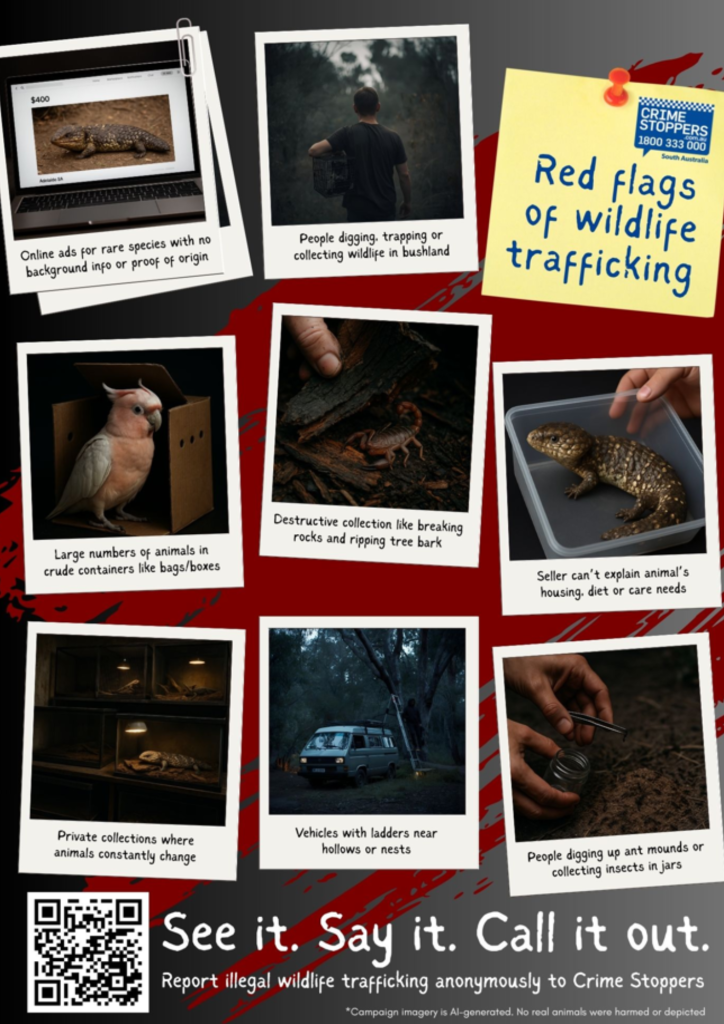
You don’t need to be an expert to help stop wildlife trafficking. If something looks suspicious, trust your gut and contact Crime Stoppers anonymously. Here are some red flags to watch out for:
In the wild
- People off-tracks turning over rocks, digging or disturbing soil, trees, logs or hollows in bushland or reserves.
- Vehicles parked off-track, hidden or in unusual spots – especially at night.
- Ladders, torches or extendable poles being used near trees, hollows or nesting areas.
- Traps, nets, cages or pitfall buckets left unattended or without permit tags.
Birds and eggs
- People with ladders or cameras near hollows, especially in national parks.
- Activity around nesting sites at night using torches or headlamps.
Reptiles and invertebrates
- People digging or flipping rocks in dry areas, often with headlamps or black lights.
- Use of tools like trowels, shovels or tweezers near burrows or ant mounds.
Online or in the community
- Sellers advertising native animals without a South Australian permit number (unless exempt species).
- Frequent listings for rare species or high turnover of different animals.
- Sellers unable to explain where the animal came from or how long they’ve had it.
- Buyers using cash, collecting animals secretly or showing little knowledge of the species.
- Neighbours with aviaries or enclosures where animals are constantly changing.
- Dead or injured native animals found in bins or cages.
In transit
- Caged native animals being transported in bulk or kept in poor conditions.
Even small details – a number plate, a suspicious listing or unusual behaviour – can make a difference.
How you can help
If you see or suspect illegal wildlife activity, don’t ignore it. Every report helps stop traffickers, rescue animals and protect South Australia’s wildlife for future generations.
You don’t have to give your name, you won’t be asked to go to court, and you can remain completely anonymous.
Report illegal wildlife trafficking here.
Call to action
Wildlife can’t call for help – but you can. That’s why we want you to remember: See it. Say it. Call it out.
Share information anonymously with Crime Stoppers here.
Every report matters. Every tip helps. Together, we can protect South Australia’s precious animals and keep them where they belong – in the wild, not in the trade.
For information about wildlife permits, including the rules regarding keeping or selling native animals or eggs, go to the DEW website.
CALL IT OUT – WILDLIFE TRAFFICKING FAQS
Call It Out is a joint initiative by Crime Stoppers South Australia and the Department for Environment and Water, which aims to:
- Expose the hidden cruelty of wildlife trafficking.
- Educate the community on what to look for.
- Empower South Australians to act by reporting anonymously.
Encourage accurate understanding of legal vs. illegal trade in native species.
Wildlife trafficking is the illegal harvest, trade and transport of native animals and their eggs. Traffickers steal animals from the wild and smuggle them in cruel, inhumane conditions to be sold locally or overseas – often as exotic pets or for breeding. Many trafficked animals suffer terribly and don’t survive capture or transport.
No. South Australia has a licensing system that allows people to legally keep, breed and trade certain native animals under strict regulations. This helps protect wild populations and ensures animals are cared for responsibly.
If you buy or sell wildlife, you must:
- Hold a valid permit or licence from the Department for Environment and Water (DEW) for species that require it.
- Display your permit number in any online listing (for species that require it).
- Only trade captive-bred animals obtained legally.
- Keep accurate records of sales and acquisitions.
Some species are exempt from permits, while others require formal authorisation. If you’re unsure, check the DEW website before trading or keeping any wildlife.
The Call It Out campaign isn’t targeting legal, responsible trade – it’s about exposing the illegal trafficking that harms wildlife and ecosystems.
It’s bigger than most people realise. Each year, authorities intercept attempts to smuggle parrots, reptiles, invertebrates and even mammals out of South Australia. Because our state’s unique animals fetch high prices on the black market, they are prime targets for traffickers and organised crime networks.
- Parrots – including Major Mitchell’s cockatoos, galahs and rainbow lorikeets.
- Reptiles – shingleback (sleepy) lizards, blue-tongue skinks, snakes and geckos.
- Bird eggs – small, easily concealed and highly valuable.
- Native mammals – possums and joeys (young kangaroos).
- Invertebrates – such as ants, scorpions, spiders and beetles, are often collected for export or private sale.
Traffickers use a range of cruel and deceptive methods, including:
- Birds stuffed into postal tubes or small boxes with air holes.
- Lizards hidden in socks, wrapped in plastic or strapped to bodies.
- Cages concealed in freight, false vehicle panels or suitcases.
- Invertebrates dug up and placed in jars or containers for transport.
Sadly, many animals die before they reach their destination.
- It causes extreme suffering – animals die from stress, suffocation or starvation.
- It damages biodiversity, causing population decline and disrupting fragile ecosystems.
- It can spread disease between animals – and even to humans.
- It’s often linked to organised crime and other illegal markets.
You don’t need to be an expert – if something feels wrong, it probably is. Here are some red flags that could indicate illegal activity:
In the wild
- People off-tracks turning over rocks, digging or disturbing soil, trees, logs or hollows in bushland or reserves.
- Vehicles parked off-track, hidden or in unusual spots – especially at night.
- Ladders, torches or extendable poles being used near trees, hollows or nesting areas.
- Traps, nets, cages or pitfall buckets left unattended or without permit tags.
Birds and eggs
- People with ladders or cameras near hollows, especially in national parks.
- Activity around nesting sites at night using torches or headlamps.
Reptiles and invertebrates
- People digging or flipping rocks in dry areas, often with headlamps or black lights.
- Use of tools like trowels, shovels or tweezers near burrows or ant mounds.
Online or in the community
- Sellers advertising native animals without a South Australian permit number (unless exempt species).
Frequent listings for rare species or high turnover of different animals. - Sellers unable to explain where the animal came from or how long they’ve had it.
- Buyers using cash, collecting animals secretly or showing little knowledge of the species.
- Neighbours with aviaries or enclosures where animals are constantly changing.
- Dead or injured native animals found in bins or cages.
In transit
- Caged native animals being transported in bulk or kept in poor conditions.
Even small details – a number plate, a suspicious listing or unusual behaviour – can make a difference.
No. Suspicion is enough. You don’t need proof or certainty. Even a car registration, unusual online listing or something overheard could be the missing piece investigators need. You share what you know and investigators will consider what your information means and next steps to be taken in any investigation.
Penalties are severe under the National Parks and Wildlife Act 1972 (SA). It’s an offence to take, keep, sell or traffic protected species without authorisation, with:
- Fines of up to $100,000.
- Imprisonment for up to two years in serious cases.
- Additional penalties under Commonwealth laws for interstate or overseas smuggling.
These laws reflect the seriousness of trafficking and its impact on biodiversity.
Wildlife trafficking is a “silent crime.” Many incidents go undetected unless someone reports suspicious activity. International demand for Australian species means South Australia remains a lucrative source market for traffickers.
- Many die during capture or transport.
- Survivors are often sold as pets, traded internationally, or used for breeding.
- Very few are returned to the wild.
Each animal taken weakens our ecosystems and threatens species survival.
South Australia’s distinctive wildlife is highly sought after both within Australia and overseas. Traffickers may sell animals:
Interstate, to unlicensed keepers, breeders or collectors.
Internationally, often to buyers in Asia, Europe and the Middle East, where Australian reptiles, parrots and even invertebrates fetch extremely high prices.
Online marketplaces, where animals are moved via covert sales, cash-in-hand exchanges or mailed across borders.
Because animals are small and easy to conceal, they are often smuggled through postal systems, freight, luggage or hidden inside vehicles. International demand for Australian species means South Australia remains a lucrative source market for traffickers.
Prices vary depending on rarity, age and species, but trafficked wildlife can fetch hundreds to many thousands of dollars per animal.
Examples from the black market include:
Rare parrots (eg Major Mitchell’s cockatoos): several thousand dollars each.
Shingleback lizards and other reptiles: often $1,000 – $5,000+ per animal, especially when sold overseas.
Native ants and invertebrates, increasingly targeted by organised crime, can sell for hundreds of dollars per colony.
High profit margins and low detection rates make wildlife trafficking extremely attractive to criminals – even more so because many animals are “free” to take from the wild.
Wildlife trafficking is one of the world’s largest and fastest-growing criminal industries. Globally, it is widely recognised as:
The third-largest illicit trade after drugs and weapons.
Worth an estimated US$7–23 billion per year.
It is driven by demand for exotic pets, breeding stock, luxury goods, traditional medicine and collector markets. Criminal networks use wildlife trafficking as a low-risk, high-profit enterprise that often overlaps with other illicit activities.
Yes – far more than most people realise.
South Australia’s unique species make it a prime target for traffickers. Authorities regularly detect attempts to smuggle:
Parrots
Shingleback and blue-tongue lizards
Snakes and geckos
Joeys and small mammals
Native ants and invertebrates
Many animals die before they reach their destination. Those that survive are sold locally or smuggled overseas in cruel, cramped and illegal conditions.
Yes. Wildlife trafficking is no longer just opportunistic – it is increasingly driven by organised crime groups because:
Profit margins are high
Detection rates are low
Penalties are lower than for drugs or weapons
Animals can be moved easily via parcels, freight or vehicles
Organised groups in Australia have been linked to illegal harvesting of birds, reptiles and even native ant colonies, which are now being collected specifically for illegal export.
Yes. Traffickers increasingly use:
Private groups
Encrypted messaging apps
Social media marketplaces
Classified listings
They often avoid using permit numbers, use fake profiles or switch accounts frequently. Community vigilance online is now as important as watching for behaviour in the bush or suburbs.
Report it online to Crime Stoppers SA at dew.crimestopperssa.com.au
You don’t have to give your name and you won’t be asked to go to court. J
ust share what you’ve seen, heard or suspect – because every report matters.
Share information online at dew.crimestopperssa.com.au
You can stay anonymous. Your report could save an animal – or stop traffickers in their tracks.
Every report could:
- Lead to an arrest and prosecution.
- Rescue animals before they suffer or die.
- Expose trafficking networks.
- Protect endangered species for the future.
No. You can remain completely anonymous, which means:
- You don’t provide your name.
- You won’t be called as a witness.
- Your information goes directly to enforcement agencies for investigation.
CAMPAIGN MATERIALS
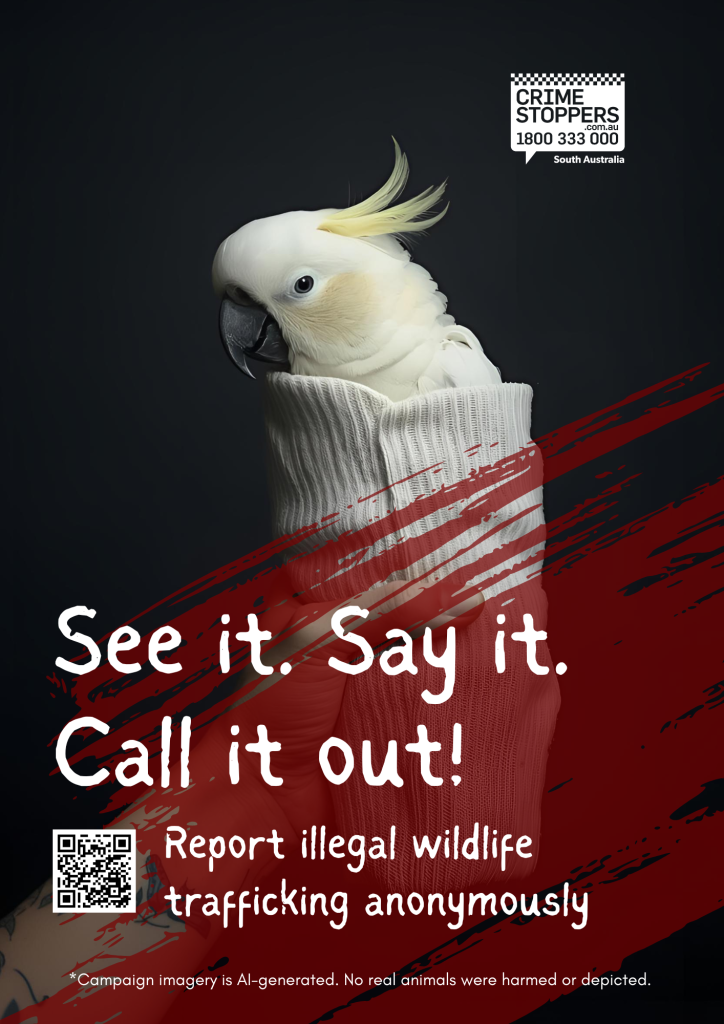
DISCLAIMER: All imagery used in the Call It Out campaign has been AI-generated for illustrative purposes only. No distressed, injured or trafficked animals were photographed or used in the creation of this campaign. The images are designed to raise awareness of the cruelty and impacts of wildlife trafficking in South Australia, but they do not depict real incidents or actual animals in distress. This approach ensures the campaign communicates the seriousness of the issue while avoiding any harm to animals.